

They say art imitates life, but this fall, NYC’s museums and galleries are giving life a serious run for its money!
As the leaves start to turn, so does New York’s art scene—and this fall, it’s turning up in a big way.
Between blockbuster museum retrospectives, gallery takeovers, and immersive experiences that blur the line between spectator and participant, the city is offering no shortage of ways to get your culture fix!
Whether you’re the type to linger over a single painting for twenty minutes or you’d rather strap on a VR headset and float through outer space, there’s something on this list built for you.
We’ve rounded up the exhibits worth clearing your weekend for this fall, so keep scrolling and start planning your next NYC art crawl.
Roy Lichtenstein: Like New at the Whitney Museum
It’s been more than 30 years since New York has gotten a major Roy Lichtenstein exhibition, and the Whitney Museum is about to make up for lost time in a massive way.
Opening October 11th, Roy Lichtenstein: Like New brings together over 130 works spanning six decades, from the early 1940s all the way through the 1990s.
This one digs into how Lichtenstein turned comics, ads, and mass-produced imagery into fine art that looked machine-made but was actually meticulously painted by hand.
Expect to see all the icons you’d hope for, including Drowning Girl, Look Mickey, and Masterpiece, alongside a genuinely wild curatorial move: the exhibition reunites all eight works from Lichtenstein’s landmark 1962 Pop debut at Leo Castelli Gallery for the first time ever, recreating that original intimate gallery setting so visitors can experience the works exactly as audiences did back in 1962.
There’s also a nearly 96-foot-long recreation of his Greene Street Mural and an outdoor presentation of Girl in Window, staged by artist and co-curator Alex Da Corte.
Yoshitomo Nara at David Zwirner
Those wide-eyed, big-headed kids staring back at you from a thousand tote bags and Instagram posts are getting their first major New York moment in nearly a decade.
Japanese artist Yoshitomo Nara is taking over two David Zwirner locations at once this fall, spanning the gallery’s 537 West 20th Street and 533 West 19th Street spaces in Chelsea, and it’s both his first solo show with Zwirner and his first big New York exhibition since the mid-2010s.
The show pairs brand new 2026 paintings with foundational works pulled from the 1980s, giving a rare look at how Nara’s style has quietly shifted over four decades.
His latest front-facing portraits lean into a more muted, nuanced color palette than the punchy tones longtime fans might expect, with diffused brushwork that gives the canvases an almost foggy, atmospheric depth.
Other new pieces start as colored pencil sketches before getting washed in translucent acrylic, and the resulting figures have this uncertain, tear-filled gaze that feels a lot more vulnerable than his earlier, punkier work.
Over at the 19th Street space, thirteen of Nara’s massive sculptural heads take center stage. Coated in matte white urethane, they’re 10-times enlargements of small clay prototypes Nara originally sculpted by hand, and they’re intentionally built to evoke the snow “monsters” he remembers from childhood winters in rural northern Japan. Standing in front of one blown up to monumental scale, watching how the light falls across that soft, oversized face, is a genuinely strange and quietly moving experience.
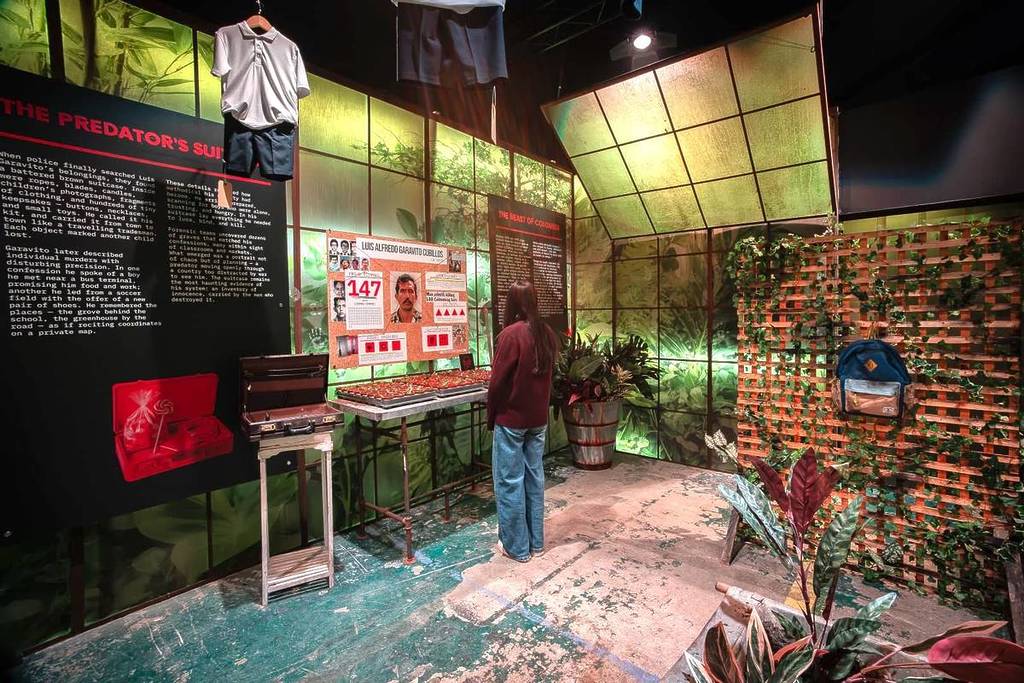
This immersive exhibition brings the US premiere of Mind of a Serial Killer to a 24,500-square-foot venue at 526 6th Avenue in Union Square, unpacking the psychology, backgrounds, and motives behind 20 of history’s most notorious serial killers.
Across more than 20 stops, visitors move through meticulously recreated crime scenes, including Ted Bundy’s Beetle and Jeffrey Dahmer’s kitchen, tracing the evolution of serial crime from the early 1900s to today’s most infamous cases.
A recreated field investigation office lets guests dig into the factors that can drive someone to commit murder, while an included VR component (in VIP tickets) places visitors directly inside a simulated investigation, tasked with uncovering the truth themselves.
The show carries a genuine warning label—graphic and disturbing content involving victims of all ages is on display—and requires guests to sign a digital waiver before entering, with an audio guide recommended for the full 90-to-120-minute walkthrough.
Krasner and Pollock: Past Continuous at the Met
This landmark Met exhibition reunites the work of Lee Krasner and Jackson Pollock, tracing their intertwined lives from their 1941 meeting in New York through their 1945 marriage and move to Springs, Long Island, until Pollock’s death in 1956.
It’s billed as the first major New York presentation devoted to either artist in more than two decades, and the first show ever to examine the full arc of both their careers side by side.
The exhibition features over 120 works and takes its subtitle from a 1976 Krasner painting, framing the show around parallel artistic lives shaped first by shared experience and later by memory.
It contrasts their distinct roots—Krasner born in Brooklyn to Ukrainian Jewish immigrant parents, Pollock raised in Los Angeles and the American West—showing how these different backgrounds converged in the rupture of Abstract Expressionism.
Visitors will see Pollock’s revolutionary “drip” technique alongside Krasner’s varied, nature- and color-driven explorations of abstraction, with the show deliberately reframing Krasner’s long-underrecognized contributions on equal footing with her husband’s.
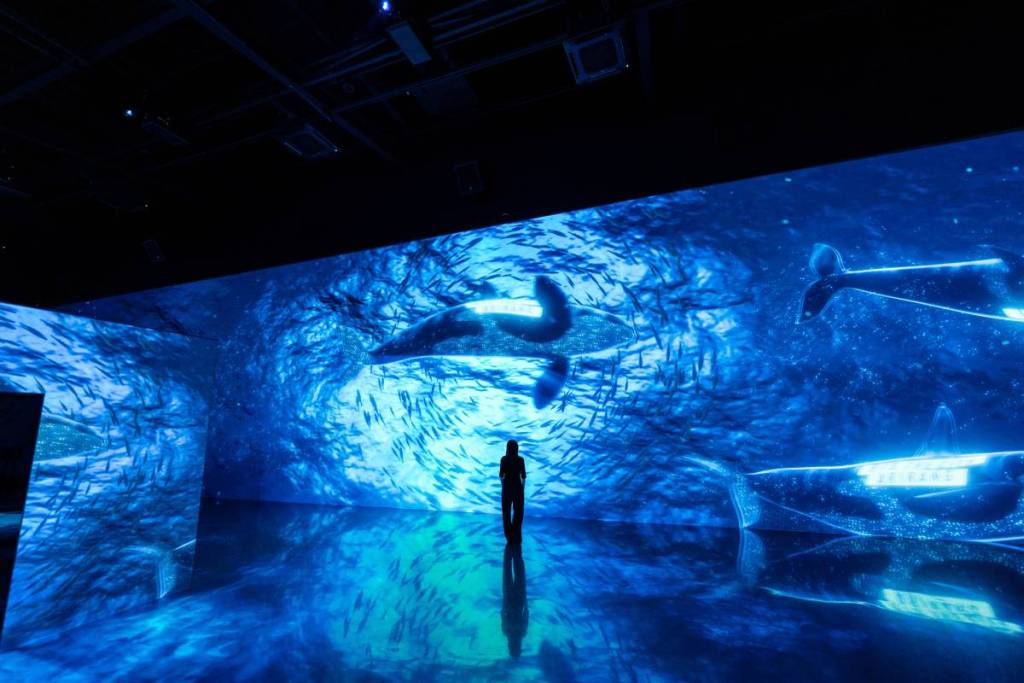
Through August 14, 2026, this Chelsea Piers waterfront installation is running a limited crossover most visitors won’t get to see twice: BTS THE CITY ARIRANG, a collaboration layering Arte Museum’s nature-inspired digital art with dedicated ETERNAL ARIRANG galleries like ARIRANG WAVE and ARIRANG GARDEN.
The show leans hard into full sensory design—composer Young-gyu Jang built an original score for the space, and perfumer Marianne Nawrocki Sabatier created custom scents pumped into specific rooms as visitors move through sweeping projected landscapes of light, sound, and movement.
The experience wraps at ARIRANG CAFE, where tea service doubles as an interactive tabletop media display.
The Genesis Facade Commission: Liu Wei, Speculation at The Met
Liu Wei has famously built architectural landmarks out of dog chews, and this fall he brings that same instinct for reconfiguring the mundane into monumental to the Met’s own Beaux-Arts facade.
Four large-scale sculptures will fill the niches of the Fifth Avenue exterior, marking the Beijing-based artist’s first major presentation in the United States and the seventh installment of the museum’s annual Genesis Facade Commission series.
Curated by Lesley Ma, the works remix familiar motifs—fragments of the urban environment, historical references, and bodily forms—into composite pieces built from a mix of materials meant to provoke complex, sometimes contradictory feelings. A recurring hand motif threads through all four sculptures, serving as a bridge between the recognizable and the fantastical, and the project as a whole grapples with cycles of rupture, resistance, mending, and creation across history rather than settling on any single narrative.
“His work always compellingly pierces through perceptions of reality with a blend of rawness and refinement,” Ma said of Liu ahead of the announcement, adding that she’s curious to see how he “challenges our expectations for the classical niches and for public sculptures.”
The commission follows Jeffrey Gibson (2025), Lee Bull (2024), Nairy Baghramian (2023), Hew Locke (2022), Carol Bove (2021), and Wangechi Mutu (2019) in a series that’s become one of the Met’s most closely watched contemporary interventions. Those who want to hear from the artist directly can catch “An Evening with Liu Wei” on September 22 at the Met Fifth Avenue.
Arthur Jafa: I Am Tony at New Museum
This is the largest museum survey to date of Arthur Jafa’s work, spanning two full floors of the New Museum’s newly expanded, OMA-designed building and covering nearly forty years of a practice that’s made him one of the most influential artists of his generation.
Named after legendary jazz drummer Tony Williams, the show maps Jafa’s evolution from his earliest films to his most recent video installations, tracking a visual language whose rhythms and syncopations deliberately echo the aspirations of Black popular music.
Alongside the debut of new work, it brings together his most celebrated pieces, including Love is the Message, The Message is Death (2016) and the Golden Lion–winning The White Album (2019), plus recent paintings, large-scale film installations, and a range of sculptural and photographic objects.
Across his career, Jafa has searched for new visual forms capable of capturing the actual rhythm and reality of Black life in America, holding the nation’s growing reckoning with institutional violence against Black communities in tension with the simultaneous ascension of Black culture, music, and entertainment at the center of American identity. The result is work that stares unflinchingly at the past while mirroring back our present-day obsession with images and endless “content.”
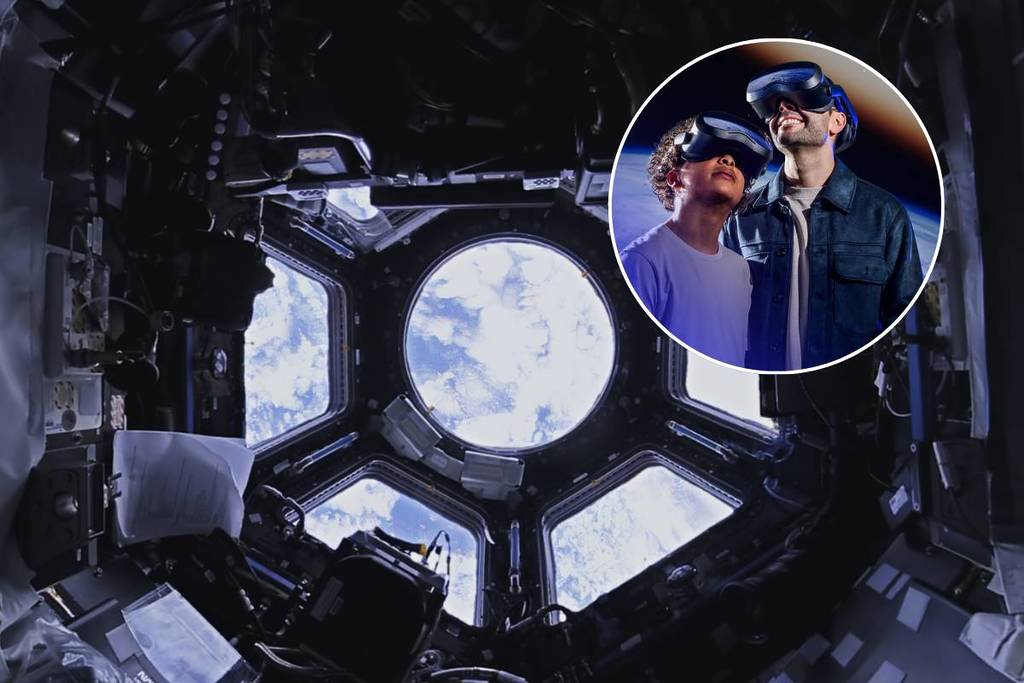
Real NASA footage, an Emmy-winning source series, and a free-roaming VR format that lets you actually walk the halls of the International Space Station—Space Explorers has made its New York debut and it’s already drawn more than 500,000 visitors at stops around the world.
The roughly 40-minute experience is built from scenes in Space Explorers: THE INFINITE, including 360-degree footage of the first-ever spacewalk captured in cinematic VR, giving visitors views of Earth from 250 miles up that most people will never see any other way.
Recommended for ages 8 and up, the show is currently running an eclipse-themed promotion through August 15, 2026, offering 10% off online tickets.
Taryn Simon: Father Country I Do Love You at Guggenheim
This Guggenheim exhibition marks the first time the museum has dedicated its entire rotunda to a new body of work by a single artist working in photography and video, and it lands during the 250th anniversary of the United States.
Ten years in the making, Father Country I Do Love You is billed as Taryn Simon’s most expansive and personal project to date, tracing the real life of one unnamed federal agent through 42 individual artworks combining never-before-seen photographs, text, videos, and sculptures into a single interactive installation.
The piece functions as a labyrinth of interconnected sagas, following the ripple effects of the agent’s actions and inactions as he worked as a middleman, gathering evidence for others to slot into a bigger picture, with consequences that reached nations and lives he’d never know.
Simon dedicates the work to her own father, who spent years traveling through Thailand, Russia, Iran, Israel, China, Afghanistan, and Korea for the U.S. government before pivoting to manufacturing arcade games—a story she began excavating only after his Alzheimer’s diagnosis made clear she’d never hear the rest of it in his own words.
Designing the Gilded Age: Drawings from the Studios of Louis C. Tiffany at The Met
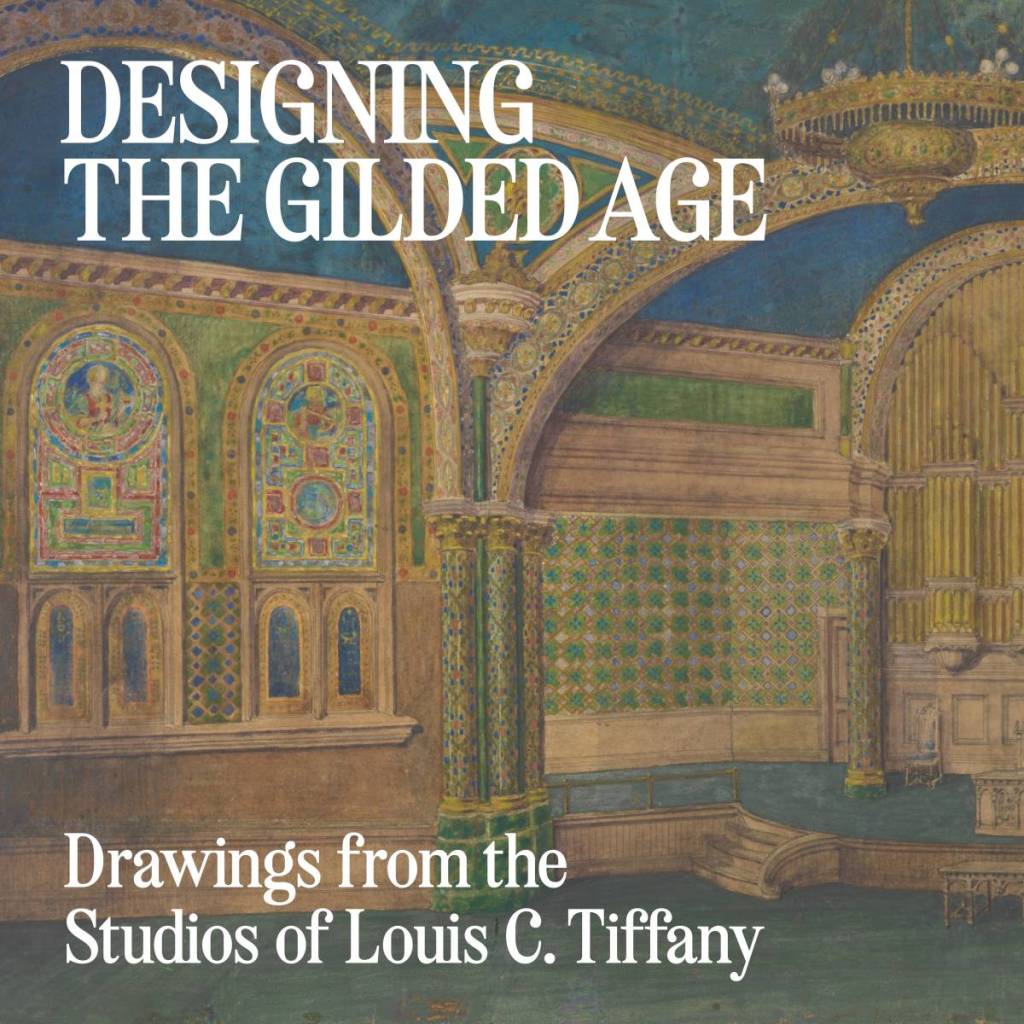
Before they became luminous stained-glass windows or iconic lamps, Tiffany Studios‘ most celebrated works began as watercolor drawings—and this fall, the Met is finally giving those working sketches their own spotlight.
The exhibition brings together nearly 120 rarely seen drawings from the Met’s collection, the largest cache of Tiffany design drawings held anywhere, alongside a select group of key loans.
Spanning commissions from the mid-1880s through the 1920s, the drawings trace the first step in the artistic process behind interiors and decorations made for grand mansions, houses of worship, and civic buildings across America and abroad, including projects in Canada, Mexico, Cuba, and Switzerland. Many document works that have since been lost, damaged, or destroyed, while others preserve ideas Tiffany’s studio never got to build—giving visitors a genuine glimpse into concepts that otherwise vanished.
The show’s centerpiece is a reunion decades in the making: the Chrysler Museum of Art’s monumental stained-glass window Woman in a Pergola with Wisteria (1911) will be displayed alongside its original wisteria transoms, recently rediscovered in a private home in Arizona.
Curator Alice Cooney Frelinghuysen calls it “a particularly powerful moment, allowing visitors to see the transformation of an idea into a luminous work of art,” and it’s the first time the ensemble has been shown together in at least half a century.
Organized thematically across domestic, ecclesiastical, and public/commercial commissions, the exhibition pairs select drawings directly with the finished stained-glass windows, mosaics, enamels, and lamps they produced, so visitors can trace a design’s full journey from graphite sketch to finished glass.
The Bowery: Devil’s Mile at New Museum
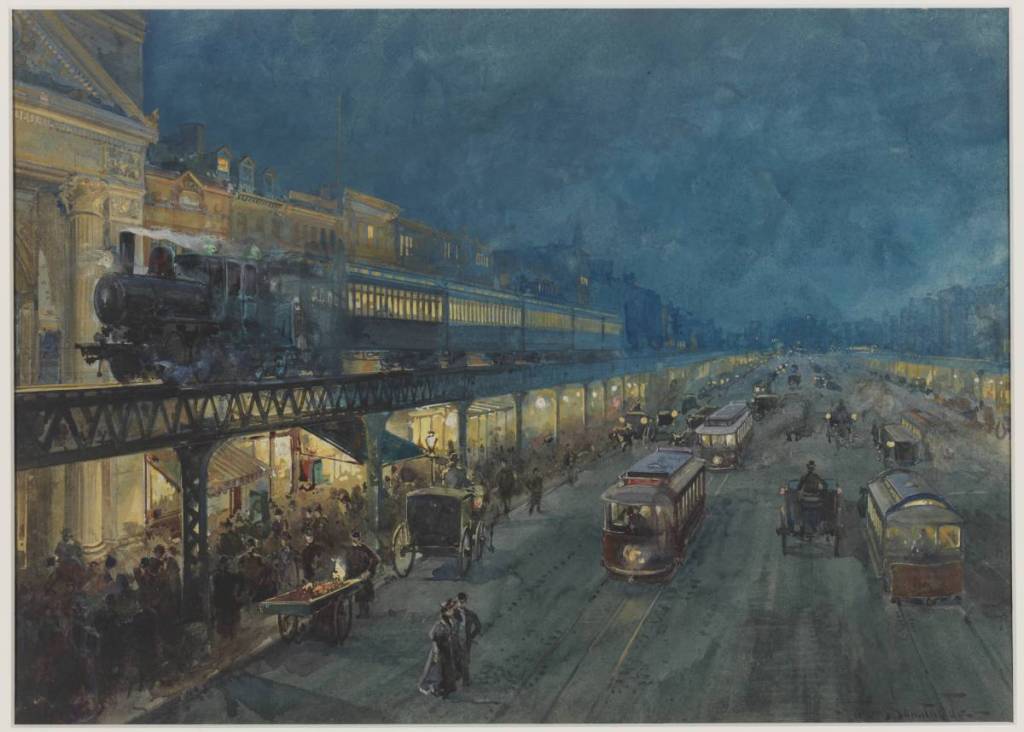
Fittingly staged on the very street it chronicles, this is the first exhibition ever to trace the full 500-year history of the Bowery, New York’s oldest thoroughfare, from Lenape footpath to skid row to the beating heart of the contemporary art world.
Curated by Director Emerita Lisa Phillips with curatorial assistant Thalia Stefaniuk, the show gathers artworks and artifacts that treat the Bowery not just as a street or a neighborhood, but as a state of mind—one defined by extremes.
The exhibition moves through the street’s many lives: farmland and cattle drives, racetracks and pleasure gardens, and later a raucous entertainment strip packed with theaters, concert halls, tattoo parlors, and dime museums. That rowdy, grit-and-muscle reputation eventually earned it the nickname “Devil’s Mile”—long before it became known as the most notorious skid row in the world, and long before it turned into the thriving artists’ community that ushered in yet another reinvention.
The cast of characters populating the show spans centuries and disciplines, from Peter Stuyvesant, P.T. Barnum, and Jacob Riis to William Burroughs, Eva Hesse, and Keith Haring—a lineup that captures just how many different New Yorks have collided on this single strip of Manhattan.
It’s a fitting subject for the New Museum to take on, given that the institution itself calls the Bowery home, now inside its newly expanded, OMA-designed building.
Mathematics and the Art of M.C. Escher at MoMath
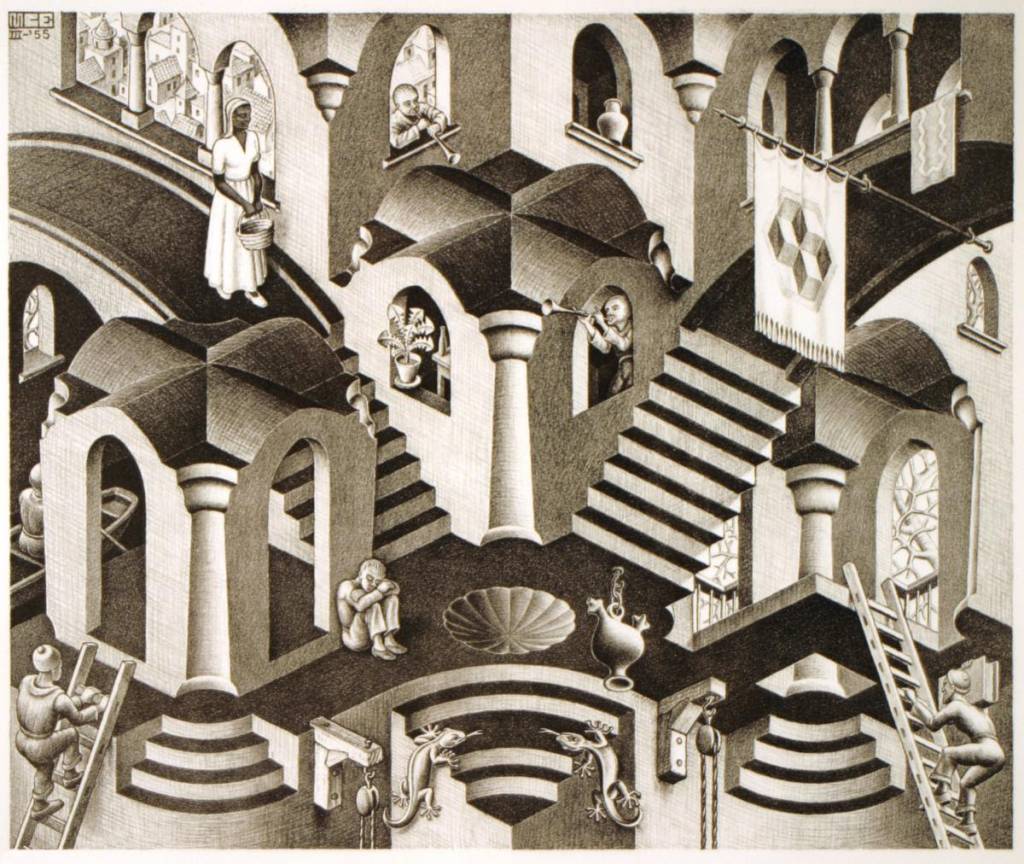
M.C. Escher barely passed his final high school math exam, yet he went on to create some of the most mathematically sophisticated artwork of the 20th century—and this fall, MoMath is finally telling that side of his story.
This marks the first major Escher exhibition in Manhattan, distinguishing itself from previous surveys by digging specifically into the mathematical structures underpinning his impossible architecture, tessellations, and visual paradoxes.
The show pulls together more than 60 wood engravings, lithographs, woodcuts, mezzotints, and drawings, plus the actual woodblocks and a lithographic stone Escher worked from, alongside three-dimensional objects he designed himself. Interpretive materials throughout the galleries decode the symmetry, infinity, geometry, and perspective embedded in each piece, letting visitors trace how a self-taught “layman’s theory” of shapes that fill a plane turned into some of art history’s most recognizable optical illusions.
The exhibition was developed in consultation with a genuinely heavyweight group of Escher scholars, including longtime expert Doris Schattschneider, MoMath outreach mathematician Chaim Goodman-Strauss, Technical University of Munich professor Jürgen Richter-Gebert, and Escher family friend David Masunaga.

This sensory playground takes over Court B, Level 3 of the American Dream mall in New Jersey, turning an entire suite of eight themed rooms into a surreal, colorful universe built almost entirely out of bubbles.
Visitors move from oversized bubble installations to a literal bubble bath (socks mandatory), using VR technology, simulators, and optical illusions to engage all five senses inside fantastical, dreamlike landscapes.
It’s designed for all ages, with kids 2 and under admitted free and children 18 and under required to bring an adult, making it as much a family day trip as a novelty photo-op.