

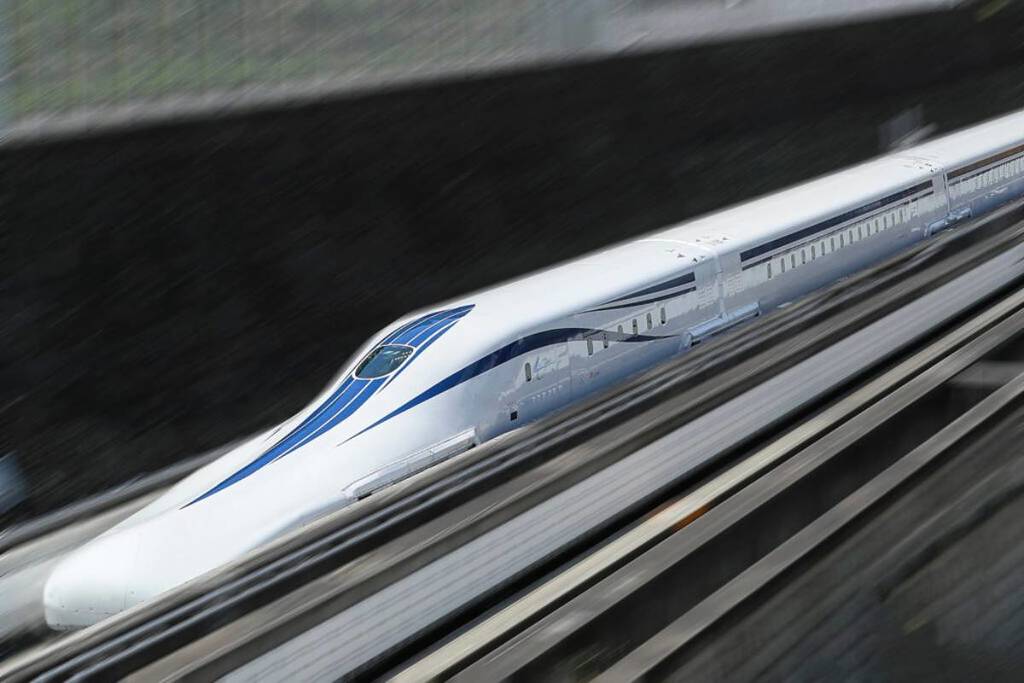
The futuristic Northeast Maglev, a magnetic levitation train that promised to connect New York City and Washington D.C. in just one hour, has officially been canceled. The proposed project, which had been in development for over a decade, will no longer receive support from the Federal Railroad Administration.
What was the Northeast Maglev?
The Northeast Maglev train was an ambitious project aimed to introduce SCMAGLEV (Superconducting Magnetic Levitation) technology to the U.S., allowing trains to travel at speeds up to 311 mph while levitating above their tracks via magnetic forces–the word maglev itself is a blend between “magnetic” and “levitation.”
Without wheels or friction, the train promised a smoother, quieter, and much faster travel experience between major Northeast Corridor cities, including NYC, Philadelphia, Baltimore, and D.C.
The first phase would’ve connected Washington D.C. to Baltimore in just 15 minutes, with eventual plans to extend the route to New York, resulting in a one-hour train ride from NYC to D.C. Currently, it takes around four hours to travel between NYC and D.C. via train.
Being the train would have had its own guideway, there would be no risk of collision with other modes of transportation. Moreover, derailment wouldn’t have been possible due to the guideways’ U-shaped design.
Fun fact: the first commercially operational maglev train opened in Birmingham, England in 1984. See the Northeast Maglev route below:

Why was the Northeast Maglev Canceled?
Despite strong enthusiasm from transportation innovators and even a working prototype in Japan, the U.S. iteration faced several major hurdles.
According to federal officials, the project encountered significant planning and environmental challenges that could not be resolved. Among the concerns were:
- Environmental impact on protected areas and wildlife
- Land use complications along the proposed route
- Cost: Estimated to be tens of billions of dollars
- Feasibility of building the required long, straight tunnels for maglev tech
Officials concluded that the route as proposed simply was not practical, with challenges that were “insurmountable.” Thus, the Federal Railroad Administration (FRA) is canceling the grants for the project due to poor planning, high costs, and opposition from community members. U.S. Department of Transportation (USDOT) Secretary Sean P. Duffy stated:
This project lacked everything needed to be a success, from planning to execution. This project did not have the means to go the distance, and I can’t in good conscience keep taxpayers on the hook for it. We’ll continue to look for exciting opportunities to fund the future of transportation and encourage innovation.
A Missed Opportunity?
The private company behind the train, Northeast Maglev, called the cancellation “a missed opportunity of a generation.” The project was expected to bring over 160,000 jobs and provide a major boost to the regional economy, all while reducing greenhouse gas emissions and easing congestion along the heavily traveled I-95 corridor.
Still, the USDOT said the resources could be better used improving existing rail infrastructure, like ongoing upgrades to Amtrak’s Northeast Corridor and the development of Brightline’s high-speed rail.
What’s Next?
While the Northeast Maglev project may be shelved, interest in high-speed rail continues to grow in the U.S., especially with countries like Japan and China pushing maglev technology forward at record speeds. In fact, some maglev trains overseas have already exceeded 370 mph in test runs.
Though this particular route won’t be built, the dream of floating trains in America isn’t entirely dead–Duffy clarified that the cancellation of the grants does not prevent MAGLEV technology from being deployed in the U.S. at some point.
For now, however, travelers between NYC and D.C. will have to continue to make use of existing options–just a bit slower than we all hoped.