


Your bags are packed, your itinerary is set, and your passport hasn’t expired yet. All good to go for your international trip, right? Wrong. Most travelers don’t realize that simply having a passport that isn’t expired yet (or even, isn’t expiring for a few months) isn’t enough to get on their flight with no issues. That’s why knowing about the 6-month passport rule is so important.
What is the 6-month rule?
The 6-month passport rule refers to the policy of many countries that require 6 months of validity on a passport beyond the date of your trip. Still, some countries only require 3 months of validity, and others just require validity through your time traveling. Though it’s labeled as a “rule,” it really is more of a recommendation, but one that the U.S. Department of State encourages as well. Every country is different and every airline handles checking at the gate differently, so it’s not worth the risk of being stopped. Essentially, having 6 months keeps you “safe” from any potential issues.
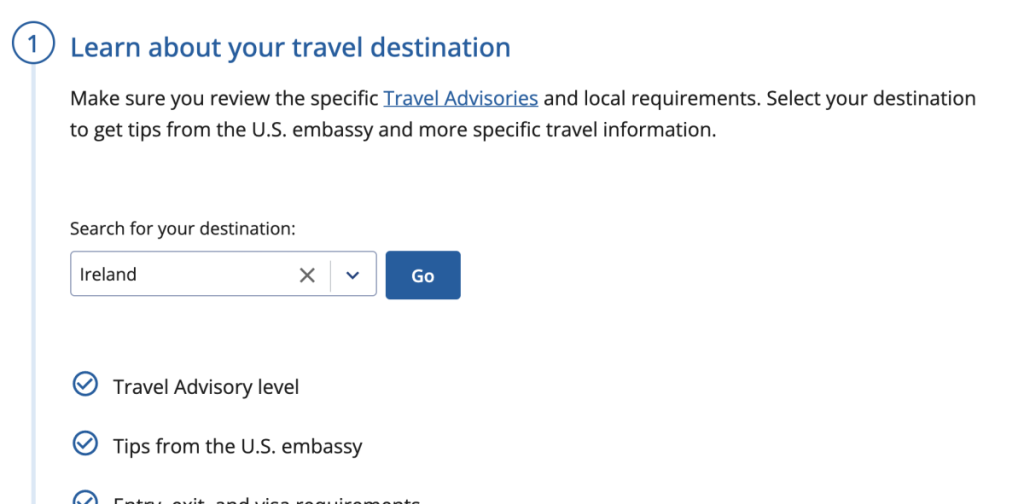
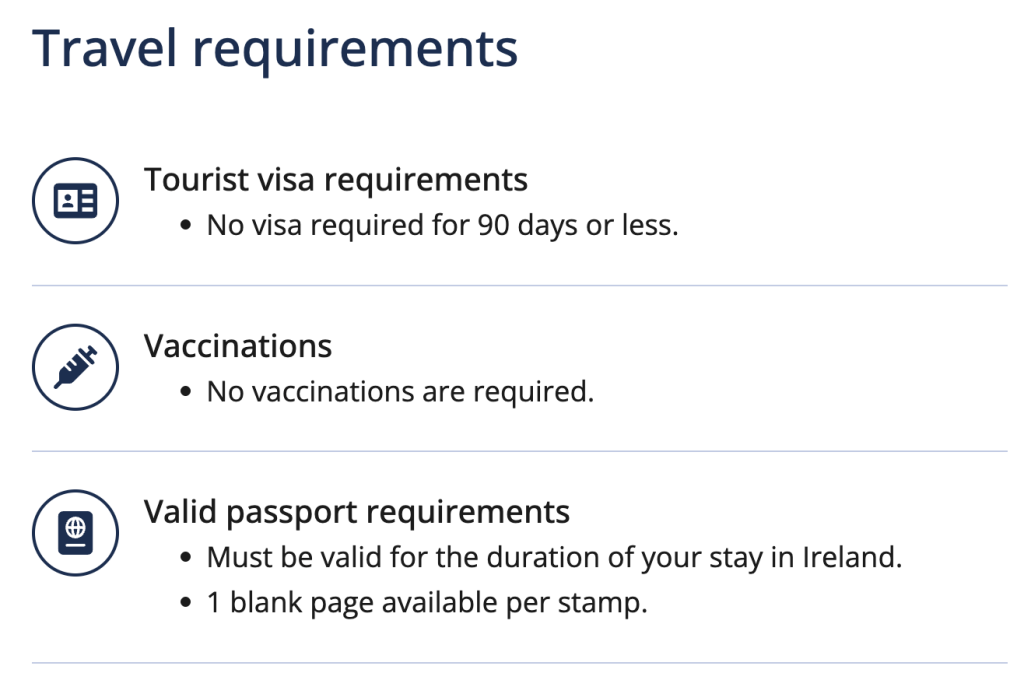
To see what the country you’re traveling to requires, head to the U.S. Department of State travel page and click on International Travel Checklist. There, you can enter your destination and then it will take you to a page that details any travel advisories, tips from the U.S. embassy and travel requirements, including required passport validity. An example for Ireland is pictured below.
Which countries require 6 months on a passport?
According to the state department’s website, there are the current countries that require 6 months of validity on a passport, but there are some nuances.
Asia & The Middle East
- Asia: Bhutan, Brunei, Cambodia, China, Indonesia, Laos, Malaysia, Maldives, Mongolia, Myanmar, Nepal, North Korea, Pakistan, Philippines, Singapore, Sri Lanka, Taiwan, Tajikistan, Thailand, Timor-Leste, Turkmenistan, Vietnam
- Middle East: Bahrain, Iran, Iraq, Israel, Jordan, Kuwait, Oman, Qatar, Saudi Arabia, United Arab Emirates, Yemen
- (Note: Turkey requires 150 days of validity, which is essentially five months).
The Americas & Caribbean
- Central & South America: Belize, Bolivia, Brazil, Ecuador (including the Galápagos Islands), El Salvador, Guatemala, Guyana, Honduras, Nicaragua, Suriname, Venezuela
- Caribbean: Antigua and Barbuda, Grenada, Guadeloupe, Haiti, Martinique, St. Barts, St. Kitts, Trinidad and Tobago
Africa
- Algeria, Botswana, Burundi, Cameroon, Central African Republic, Chad, Cote d’Ivoire, Democratic Republic of the Congo, Djibouti, Egypt, Equatorial Guinea, Eritrea, Ethiopia, Gabon, Kenya, Madagascar, Malawi, Mauritania, Morocco, Mozambique, Namibia, Rwanda, Sao Tome and Principe, Somalia, South Africa, South Sudan, Sudan, Tanzania, Uganda, Zambia, Zimbabwe
The South Pacific
- Fiji, French Polynesia, Kiribati, Marshall Islands, Palau, Papua New Guinea, Tonga, Tuvalu, Vanuatu

Which countries require 3 months validity on passports?
The European Schengen Area, which is a group of 29 countries that follow the same travel and immigration rules, requires 3 months of validity beyond your departure. “Ensure your passport is valid for your entire stay plus an additional 3 months,” the state department writes. These countries are:
- Austria
- Belgium
- Bulgaria
- Croatia
- Czechia/Czech Republic
- Denmark
- Estonia
- Finland
- France
- Germany
- Greece
- Hungary
- Iceland
- Italy
- Latvia
- Liechtenstein
- Lithuania
- Luxembourg
- Malta
- Netherlands
- Norway
- Poland
- Portugal
- Romania
- Slovakia
- Slovenia
- Spain
- Sweden
- Switzerland
Still, each airline has different requirements. Some enforce a blanket 6 month rule and don’t base it on each country’s individual requirement, which is why the state department recommends 6 months. This also takes into account a “buffer” time in case there are unforeseen issues like illness/hospitalization, natural disasters, or other issues that could leave you stuck.
How exact is the 6 month passport rule?
As stated, it depends on both the country and the airline. Some are very strict on the 6-month requirement, others require 3 months, and still others require only validity during the duration of your stay. Still, each airline has its own policy and at the end of the day you are beholden to who is checking you in at the gate. That’s why the “6 month rule” is more of a precaution and recommendation.
For example, Delta’s website states “In general, your passport must be valid for at least six months beyond the period of intended stay in a foreign country.” United’s website states, “Some countries require your passport to have at least 6 months left before it expires.” It directs to checking each individual country on the State Department’s website as well. American Airlines states “Some countries require your passport to be issued at least 6 months before the day you arrive. Check your destination’s requirements if you’re unsure.” Theoretically if your country only requires 3 months of validity you should be able to get on the flight, but it’s better safe than sorry.
How serious is the 6 month passport rule?
It’s very serious for the countries requiring it. Your airline may not allow you to board without a full 6 months on your passport. For the countries requiring less, it still it up to the attendant’s discretion.
Can I fly with my passport expiring in 6 months?
Again, it depends on where you are going. If you have at least 6 months, you should be good. If you have less than that, check your destination’s requirement and also call your airline to confirm their policy.