
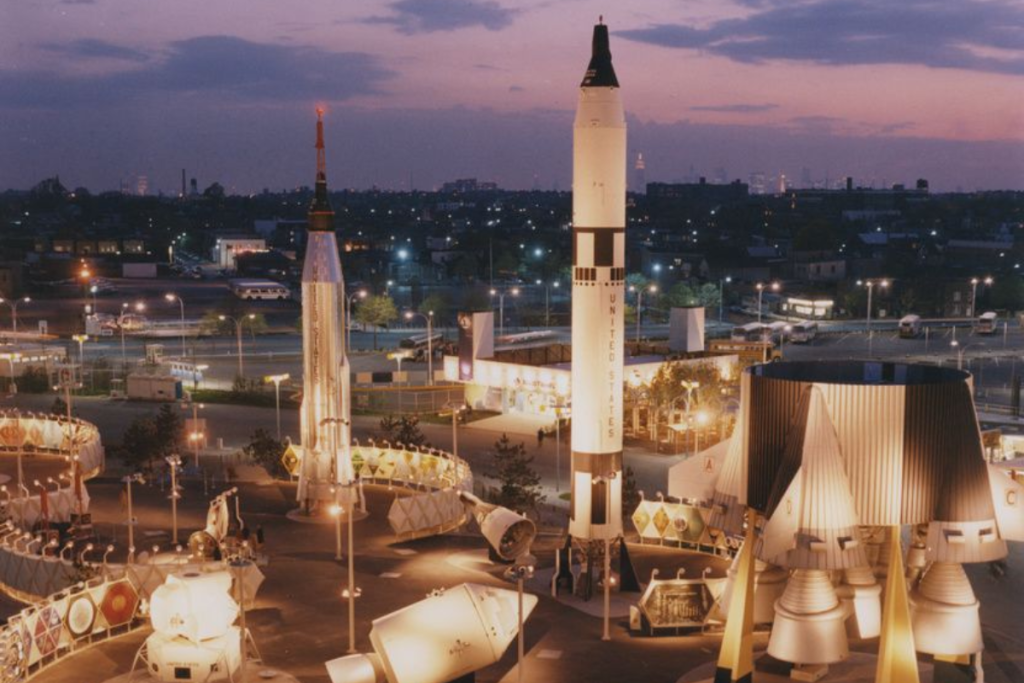

Forgive our biases, but we just so happen to think New York City is the best city in the universe. And now, New Yorkers can get a little closer to the cosmos without ever leaving the ground—or, better yet, our favorite city.
This week marks World Space Week, an international celebration of space exploration, science, and technology held each year from October 4 through 10. And to celebrate, the New York Hall of Science is giving visitors the chance to get up close with some seriously impressive pieces of space history.
Throughout the week, visitors can see real NASA artifacts from the Mercury and Gemini programs, including massive rockets, a Mercury capsule, and a Saturn V F-1 engine—the powerful engine that helped send astronauts toward the moon. So yes, you can essentially take a trip through American space history without boarding a rocket yourself.
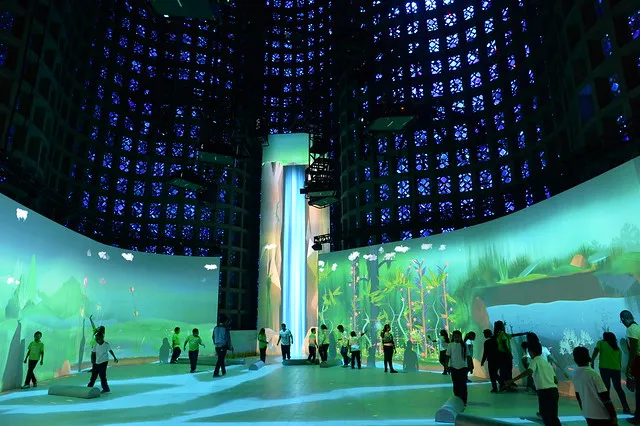
And because October in NYC is also Archtober, the museum is spotlighting another piece of the city’s history: its spectacular Great Hall, originally built for the 1964–65 World’s Fair. With soaring 100-foot ceilings and thousands of cobalt-blue glass panels, the space is an architectural relic that feels pretty fitting for a museum celebrating the wonders of the universe.
🔭 Stand Next to Real NASA Rockets in Queens
Step into Rocket Park to see authentic spaceflight artifacts from NASA’s early missions that helped pave the way for human space travel:
- Mercury-Atlas D Rocket: The largest rocket used in NASA’s Project Mercury (1958–1963), built as an intercontinental ballistic missile designed to put America’s first astronauts into orbit.
- Gemini-Titan II Rocket: A second-generation intercontinental ballistic missile with 2.5 times the payload capacity of the Atlas, built to carry two-person Gemini crews into space using instant-launch propellants.
- Saturn V F-1 Engine: Walk directly beneath the most powerful single-nozzle rocket engine ever built. Just one F-1 engine produced as much thrust as all three Space Shuttle main engines combined.
- Mercury-Atlas D “Friendship 7” Replica Capsule: Experience the tight 3,000-pound capsule identical to the one John Glenn piloted on February 20, 1962, becoming the first American to orbit Earth.
🚀 Step Inside the ‘Cathedral of Science‘
Suspended from the ceiling of NYSCI’s Central Pavilion is an authentic Mercury Capsule that flew in May 1960 to test NASA’s emergency escape tower system.
Beyond space artifacts, NYSCI’s architecture is an attraction in its own right. Designed by legendary architect Wallace K. Harrison for the 1964–65 World’s Fair, the Great Hall—often called the “cathedral of science”—features 100-foot-high undulating walls inlaid with 5,400 blue dalle de verre glass panels set in concrete. Stepping inside casts a shimmering, atmospheric blue glow that feels surprisingly like floating in deep space.
🪐 How to Visit: Location, Dates, and Details
- 📍 Location: New York Hall of Science, 47-01 111th St, Corona, NY 11368
- 🚀 World Space Week: Sunday, October 4 – Saturday, October 10
- 🏛️ Archtober Events: Thursday, October 1 – Saturday, October 31
- 🖼️ Featured Exhibits: CityWorks (urban planning interactive), Mathematica (reimagined by Charles & Ray Eames), and Romina Gonzales’s Finding the Window glass installation
- 🌐 Official Website: nysci.org