

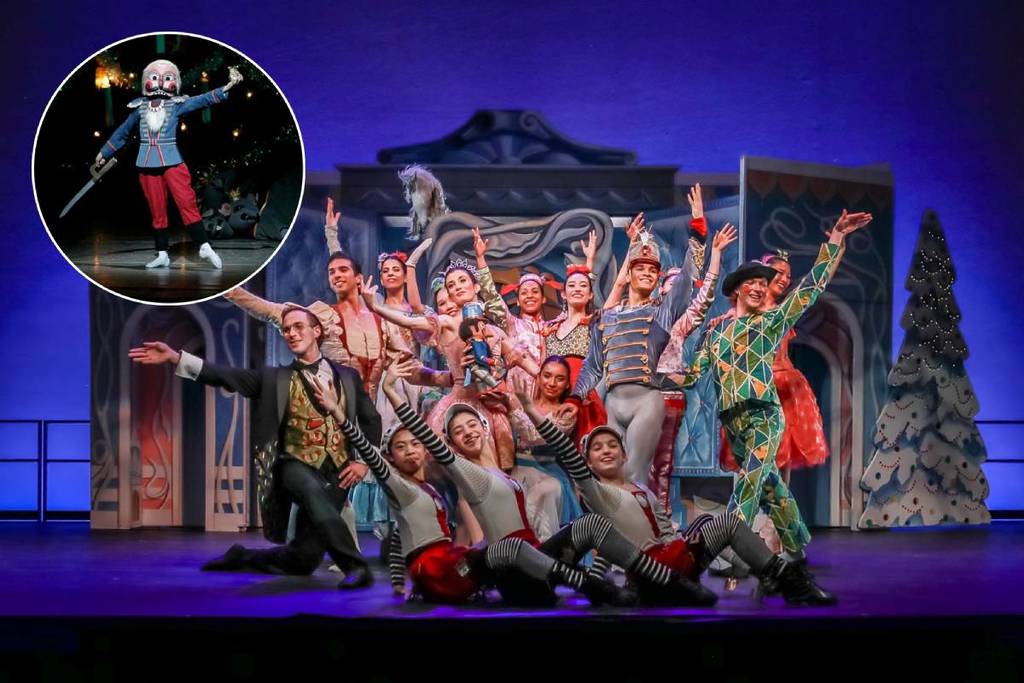
For many New Yorkers, it simply isn’t the holiday season until the lights dim at Lincoln Center, the celesta rings out, and the Sugarplum Fairy floats onstage. George Balanchine’s The Nutcracker has become a quintessential NYC holiday tradition–drawing tens of thousands of families each year–but the very first New York City Ballet performance in 1954 was almost nothing like the lavish spectacle we know today.
In fact, Balanchine’s debut version was smaller, moodier, more mysterious, and far closer to the dark 19th-century tale that inspired it.
As the production has hit a milestone 70 years on the NYCB stage, here’s the fascinating story of how The Nutcracker arrived in New York–and how Balanchine’s early vision reshaped a global holiday phenomenon.
A Holiday Staple With Surprisingly Mysterious Roots
Before it became a glittering holiday ballet, The Nutcracker began in 1816 as a far darker story: E.T.A. Hoffmann’s The Nutcracker and the Mouse King.
Hoffmann’s version included everything from creepy transformations to a mouse queen’s curse and a Nutcracker who was far more hideous than charming. The story was later mellowed out by Alexandre Dumas in 1844–turning Marie into “Clara” and making the tale more whimsical–which became the basis for the 1892 ballet at the Imperial Mariinsky Theatre in St. Petersburg.
George Balanchine grew up performing in that very production, dancing as mice, toy soldiers, and eventually the Nutcracker Prince himself, before he eventually moved to the U.S. and co-founded the New York City Ballet.
NYCB’s First Nutcracker In 1954 Was A Bold Experiment
When New York City Ballet first staged its own full-length Nutcracker on February 2, 1954 at City Center, American audiences weren’t very familiar with the ballet. Naturally, Balanchine ran with this.
Rather than simply adapting the Russian version he grew up with, he returned to the original source material, restoring moments from Hoffmann’s story that most productions had removed. This meant:
- Marie was given her original last name, Stahlbaum, a nod to Hoffmann’s more symbolic storytelling
- Elements of the plot carried a slightly darker undertone, hinting at the eerie magic and surreal transformations that defined the novella
- The production was visually minimal, with cloud-like sets, a small growing tree, and a more dreamlike, mysterious quality
- Angels and characters looked entirely different from their modern counterparts, with simple, older costumes, limited space, and hand-painted backdrops
Though many would say it was charming, the first production was far from the spectacle people are used to today.
A Version That Looked Almost Nothing Like Today’s NYC Holiday Spectacle
As it turns out, NYCB’s original 1954 performance wasn’t just moodier–it was also restricted by the small City Center stage and a limited budget.
Compared to today’s spectacle, the 1954 version differed in various ways, some of which included the growing Christmas tree being shorter and far less dramatic–today it weighs one-ton and stands 41 feet tall, and simpler Sugarplum Fairy costumes–the same tutu was worn for the entire act.
Even the choreography was different. Balanchine restored cuts to Tchaikovsky’s original score and rebalanced scenes to align more closely with the earliest versions of the ballet.
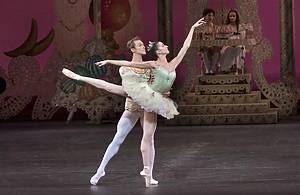
In 1964, The Nutcracker Transformed Into The Version NYC Knows Today
The true transformation came a decade later when NYCB moved to the newly built New York State Theater (now the David H. Koch Theater). The 1964 redesign introduced:
- Rouben Ter-Arutunian’s massive new sets, including towering pines and 50 pounds of snow each night
- Karinska’s now-iconic costumes, such as Sugarplum’s signature pink-and-green dual looks
- A reimagined Coffee solo, choreographed for the statuesque Gloria Govrin
- The famous 41-foot Christmas tree, engineered to grow in real time
- The smallest angels ever, played by NYCB’s tiniest SAB students–a Balanchine tradition meant to give children an entry point onto the stage
This was the moment The Nutcracker evolved into the beloved family tradition that defines New York’s holiday season today.
70 Years Later, It’s Still The Most Magical Show In NYC
Today’s production is one of the most ambitious theatrical ballets in the country, with 90 dancers, 62 musicians, 40 stagehands, and more than 125 children bringing the world of Marie Stahlbaum, the Prince, and the Sugarplum Fairy to life each year.
For New Yorkers, it has grown into something much bigger: a shared holiday memory, a multigenerational ritual, and one of the city’s most magical annual traditions.