


The familiar three-armed subway turnstile is getting more competition.
New fare gates are headed to another 20 NYC subway stations, including Union Square, Bedford Avenue, Flushing–Main Street, and Yankee Stadium, after the MTA reported a 35% average reduction in fare evasion at the stations where it tested the designs.
Governor Kathy Hochul announced the results and the next locations this morning, Wednesday, October 7.
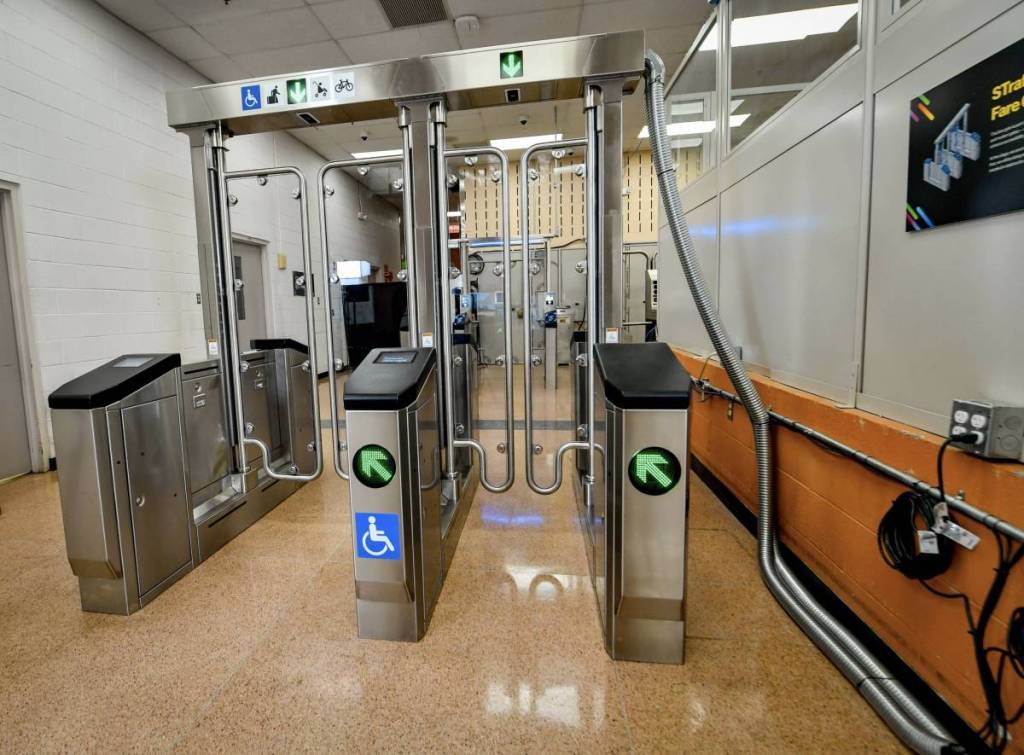
For riders, the change is about more than what the entrance looks like. The modern gates are designed to make it harder to enter without paying while giving people with wheelchairs, strollers, and luggage a smoother route through.
Anyone who has tried to maneuver a suitcase through a spinning metal tripod can probably appreciate the ambition.
Early station preparation is expected to begin this month, with gate installations starting by the end of 2026.
Here’s what the MTA says the pilot achieved, and which stations are next.
What did the new gates actually change?
The pilot tested designs from three companies, Cubic, STraffic, and Conduent, at 20 stations. Some locations received a completely replaced fare-control array, while others received only a new wide-aisle access gate. The vendors supplied the pilot equipment at no cost to the MTA.
According to the governor’s announcement, fare evasion fell by an average of 35% at those stations. The largest reported drops were:
- Hoyt Street, serving the 2 and 3: 72%.
- Nostrand Avenue, serving the A and C: 72%.
- Third Avenue–138th Street, serving the 6: 65%. 1565
Those figures describe reductions at the pilot stations, not a 35% decline across the entire subway system.
The MTA began evaluating the gates last fall, looking at fare evasion alongside accessibility, customer experience, entry and exit flow, maintenance, and detection accuracy. Officials say the designs were adjusted throughout the pilot based on performance and rider feedback.
The equipment has already seen plenty of use: approximately 29 million entries and 34 million exits have been recorded since the pilot began. Those are trips through the gates, not 63 million individual riders.
These 20 subway stations are next
The next phase covers six stations in Brooklyn, six in Manhattan, four in the Bronx, and four in Queens. Unlike pilot locations that received only a wide-aisle gate, the announcement says these stations will receive new gates across all entrances. 1557
Brooklyn
- 36th Street: D, N, R.
- Bedford Avenue: L.
- Coney Island–Stillwell Avenue: D, F, N, Q.
- Hoyt–Schermerhorn: A, C, G.
- Myrtle Avenue: J, M, Z.
- Newkirk Plaza: B, Q.
The Bronx
- Third Avenue–149th Street: 2, 5.
- 161st Street–Yankee Stadium: 4, B, D.
- Fordham Road: B, D.
- Parkchester: 6.
Manhattan
- 14th Street–Union Square: 4, 5, 6, L, N, Q, R, W.
- 72nd Street: 1, 2, 3.
- 86th Street: 4, 5, 6.
- 125th Street: 4, 5, 6.
- Chambers Street: 1, 2, 3.
- Spring Street: C, E.
Queens
- Astoria Boulevard: N, W.
- Flushing–Main Street: 7.
- Forest Hills–71st Avenue: E, F, M, R.
- Sutphin Boulevard/Archer Avenue–JFK Airport: E, J, Z. 1565
The train lines matter here. “86th Street,” for example, means the Lexington Avenue station serving the 4, 5, and 6, not every station sharing that name.
When will the gates arrive?
The MTA has qualified Cubic, STraffic, and Conduent to compete for the next phase. Bids are due this month, and early station preparation work is expected to begin in October with new gates set to begin being installed by the end of 2026.
That does not mean every entrance at all 20 stations will be finished before New Year’s Eve. The announcement gives a start window, not a station-by-station completion schedule.
A second phase will bring another 30 stations into construction by the end of 2027. Together with the original 20 pilot locations and the next 20, that would bring the program to 70 stations once those phases are completed.
The wider MTA modern fare-gate program targets 150 stations.
It is part of a $1.1 billion investment in fare-control upgrades under the agency’s 2025–2029 Capital Plan, covering stations that serve nearly three-quarters of daily subway riders. 1556
A redesign beyond stopping turnstile jumping
The existing three-wheel turnstiles began appearing in the early 1990s, making this the first comprehensive overhaul of the fare-control system in more than 30 years. They were built for the token era, not for everyone arriving with a stroller, mobility device, or airport-sized suitcase.
The new designs use sensors and longer double doors intended to deter jumping over or crawling underneath. Officials also describe the touch-free passage as an accessibility improvement, allowing riders to move through without pushing a turnstile arm.
For now, the next 20 locations are the ones to watch. The MTA says the pilot is working, and more riders will soon get to test the entrance experience for themselves.