

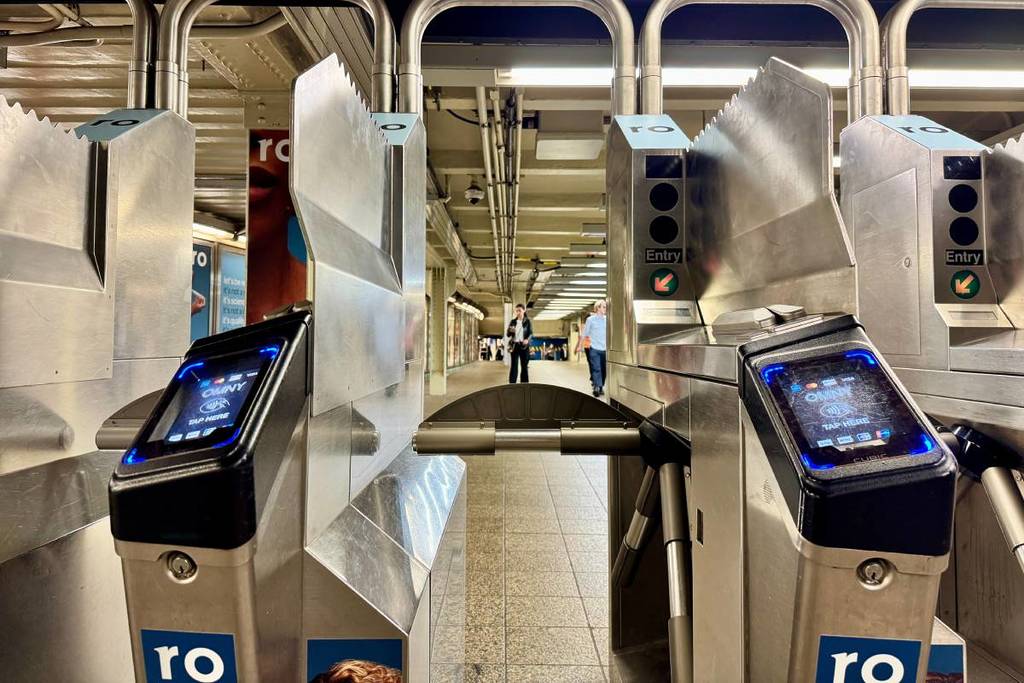
In the MTA’s relentless fight against fare evasion, the agency announced it will spend $7.3 million to install spikes and paddles on nearly every NYC subway station turnstile, with 129 stations set to be upgraded by the end of January 2026.
The subway is no stranger to fare evasion tactics–between installing modern fare gates, AI software, and tweaking turnstiles to prevent back-cocking, a tactic where riders pull back the turnstile arm just enough to slip through without paying, the MTA has been working tirelessly to not lose out on what they estimate to total around $900 million to over $1 billion in fare evasion annually, according to 2024 estimates.
The MTA began equipping turnstiles in subway stations all across NYC with “half moons” and “turnstile fins” earlier this year to make it harder for straphangers to skip out on paying their fare, and they’re making it very clear they’re not stopping there.
According to documents published by the agency, the MTA will spend $7.3 million to install spikes and paddles on nearly every subway turnstile in New York City.
The new features have already been installed at 327 of the city’s 472 subway stations, with transit officials reporting a reduce in fare evasion by 60% at these stations, and another 129 will arrive by the end of next month. NYC Transit President Demetrius Chrichlow stated:
Some members of the public might think these interventions just look funny, but the truth, the truth of the matter is these modifications work.
The 3-foot tall metal fins, which are installed between turnstiles, feature spikes on the top, preventing straphangers from grabbing the sides of the turnstile and hoisting their body up to hop over. The paddles attach to the turnstiles themselves, and can trip those who try to leap over.
The features, which Louis Montanti, a procurement manager at the MTA, described as an “emergency order,” criticism from MTA board members who are supposed to have oversight of the MTA’s contracts.
Board member David Jones even questioned the safety of the new attachments, particularly pointing to younger people who may try to hop the turnstiles regardless of the new barriers.
Still, MTA spokesperson Tim Minton said back in May that agency officials determined that fare evasion had reached a level that required immediate action, with officials seeking to purchase the fare gate attachments without board approval just a day later.
Though the $7.3 million budget sounds like a lot, it doesn’t compare to the agency’s overall budget of $1.1 billion set aside to install entirely newly designed sets of fare gates at 150 stations through its five-year construction plan, four of which will be installed at 20 stations later this month as part of a program announced back in April.