
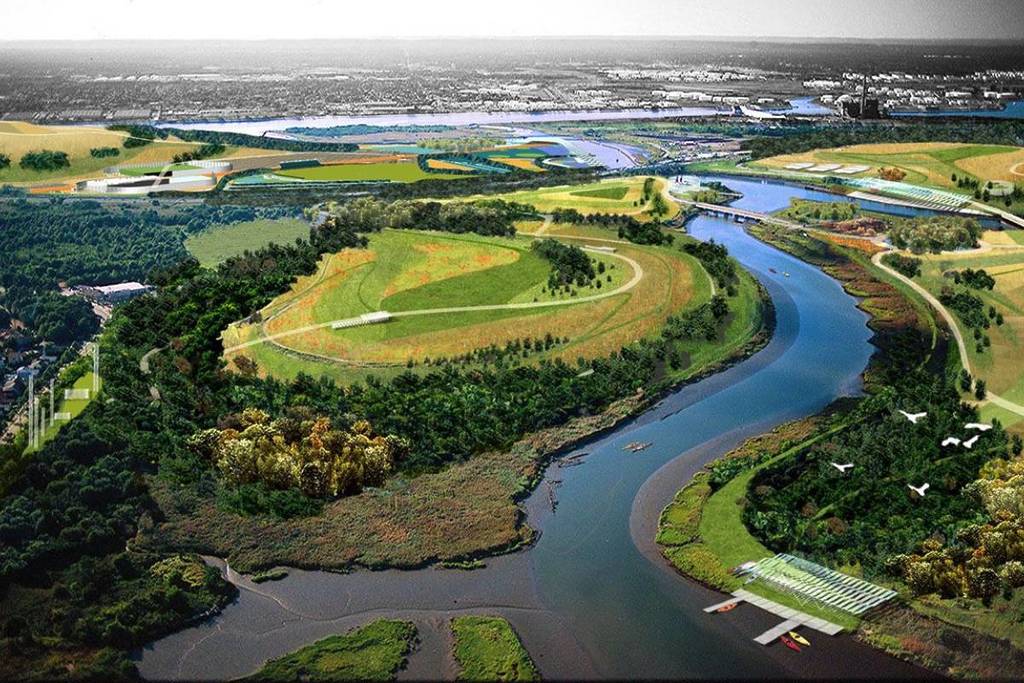

One of NYC’s most ambitious and exciting ongoing projects is quietly taking shape on Staten Island, and chances are, most New Yorkers still haven’t heard much about it yet.
For decades, the massive stretch of waterfront land that is Freshkills Park sat completely off-limits to New Yorkers, hidden behind fences and tied to the city’s industrial past.
After years of transformation, NYC is quietly turning the former infrastructure site into a sprawling 2,200-acre public oasis, one that will eventually be nearly three times the size of Central Park, complete with waterfront trails, green space, wetlands, and sweeping skyline views.
As Freshkills Park explains on its website:
At 2,200 acres, Freshkills Park is almost three times the size of Central Park and the largest park to be developed in New York City in over 100 years. It also has a significant history as the site of the Fresh Kills Landfill, which was the largest landfill in the world before closing in 2001. Since then, the landscape has been engineered with layers of soil and infrastructure, and the area has become a place for wildlife, recreation, science, education, and art.
The history
Opened in 1948 under the direction of Robert Moses, the Fresh Kills Landfill was originally intended as a temporary, three-year solution to New York City’s rapidly growing waste crisis. Instead, it evolved into a massive multi-decade operation.
The site eventually became a stark symbol of urban environmental neglect, infamous for its severe impact on Staten Island residents and the surrounding environment.
After decades of persistent community activism, the landfill accepted its final barge of residential waste and officially closed its gates in March 2001.

The transformation from an ecological wasteland into a safe public park is a marvel of modern environmental engineering. Managed by the NYC Department of Sanitation, the four massive garbage mounds are sealed using a sophisticated, multi-layered “cap.” This capping system features:
- Thick impermeable geotextile membranes that prevent rainwater from seeping into the waste.
- An intricate underground network of wells and pipes designed to safely capture methane gas (which is purified and sold to heat local homes) and leachate (highly concentrated wastewater, which is sent to an on-site treatment plant).
- Layers of clean soil and sand topped with native grasses to establish a thriving, engineered ecosystem.
Current Phases: What is Open Right Now?
Because building a park over a former landfill requires careful environmental monitoring and years of gradual ground stabilization, the transformation is being rolled out in phases through 2036.
Still, the once “forbidden” Freshkills site is no longer off-limits, and several perimeter and interior sections of the park are already welcoming visitors.
- North Park Phase 1 (Opened October 2023): This marked a monumental milestone as the first 21-acre section inside the actual former landfill boundary opened to the public. Accessible via Wild Avenue, it features sweeping waterfront views, multi-use pedestrian and cycling paths, a forested tree nursery, and a striking 20-foot bird observation tower overlooking Main Creek. True to its eco-friendly mission, the section features solar-powered fixtures and a completely waterless composting restroom.
- Schmul Park (Opened 2012): Serving as a vibrant neighborhood gateway in Travis, this former asphalt playground was completely rebuilt into a green space with permeable pavement, native plantings, and modern playground facilities.
- Owl Hollow Fields (Opened 2013): Located on the park’s southeast edge, this active recreation hub offers four synthetic turf soccer fields (two illuminated for night play), a loop pedestrian path, and expansive lawn areas.
- New Springville Greenway (Opened 2015): A beautifully landscaped 3.3-mile multi-use paved path that runs parallel to Richmond Avenue, offering a critical buffer and a scenic route for local cyclists and runners.

Beyond the permanently open zones, the Freshkills Park Alliance hosts regular guided preview events, including kayaking tours along the tidal creeks, photography workshops, and birdwatching excursions. The area has successfully become one of the most vital native grasslands in the Northeastern U.S., now supporting over 200 species of birds, mammals, and reptiles.
Future Plans: Looking Toward 2036 and Beyond
The master plan for Freshkills Park envisions five distinct sub-parks, each with its own unique ecological and recreational identity. Over the next decade, development will expand into the heart of the site:
- South Park (~425 Acres): Designed for active recreation. NYC Parks is transitioning into construction on massive multi-use synthetic turf fields, woodland restoration, and trail networks connected to Owl Hollow.
- East Park (~482 Acres): Programmed for sweeping scenic meadows, extensive trail networks, and open picnic areas. Long-term plans also include an integrated road system to safely connect Richmond Avenue to the West Shore Expressway.
- West Park (~545 Acres): Currently undergoing long-term capping and environmental stabilization. It is slated to feature expansive, rolling grasslands and a massive monument acknowledging the site’s history.
- The Confluence (~70 Acres): Positioned at the convergence of the park’s major tidal creeks, this will serve as the lively waterfront core of the entire park, featuring a visitor center, a public marina, kayak launches, restaurants, and open-air event spaces.
When completely finished in the late 2030s, Freshkills Park will hold the title of the second-largest public park in New York City—surpassed only by Pelham Bay Park in the Bronx—solidifying its status as one of the greatest stories of environmental reclamation and urban renewal in human history.