

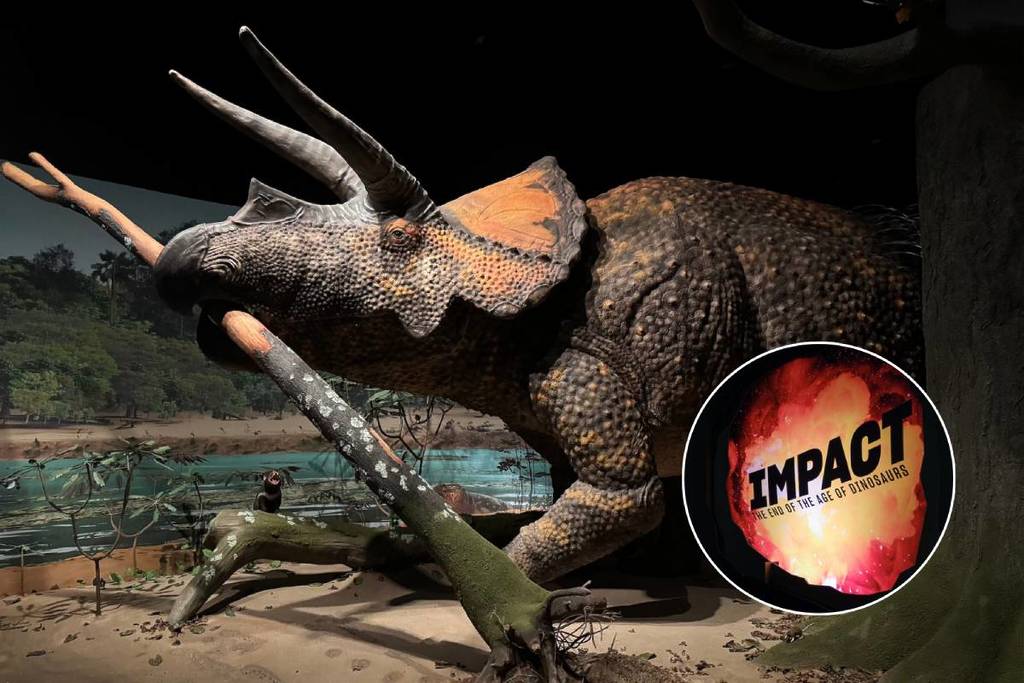
How did we start off our Wednesday morning, you ask? Well, we stepped back in time to 66 million years ago–but no, we didn’t finally figure out time travel. Rather, we took a little trip back to a time when dinosaurs roamed the Earth at the American Museum of Natural History’s newest exhibit, Impact: The End of the Age of Dinosaurs.
The new exhibit explores the major asteroid impact 66 million years ago that reshaped life on Earth, triggering earthquakes, tsunamis, and global wildfires before finally plunging the planet into darkness and wiping out most species. But while life as many species knew it came to an end there, the exhibit continues on.
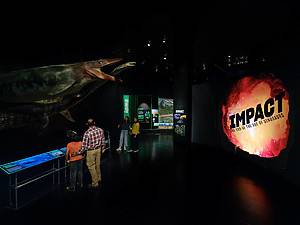
Impact focuses not only on, well, the impact, but also on the period of renewal that followed the asteroid. The exhibit explores the new ecosystems that evolved, how mammals diversified, and, ultimately, the pivotal moment when humans emerged. Museum President Sean M. Decatur stated:
It’s a story about the resilience of life and of our planet. Some species survived, new ecosystems flourished, and eventually these developments led to the evolution of humans and the world we know today. It’s a fascinating, extraordinary story like no other.
The exhibit places you in the crux of the Cretaceous Period, getting an up-close look at fossils and fossil casts, immersive animations, life-sized models, dramatic dioramas, and more. Highlights include:
- An 18-foot-long Triceratops pulling down a small tree
- A 27-foot-long Mosasaur attacking a long-necked plesiosaur measuring 30 feet
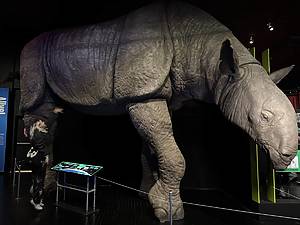
- A 15-foot-tall plant-eating ancient mammal
- A touchable cast of a mosasaur tooth
- A real fossil of an ammonite
- A 6-minute immersive panoramic video that visualizes the moment the asteroid struck Earth with the force of billions of nuclear weapons
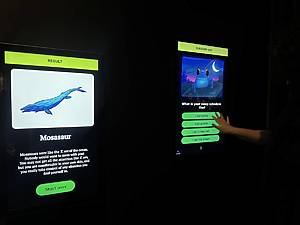
- A personality quiz that matches you with a Cretaceous animal–and the chance to find out whether “you” survived the asteroid or not
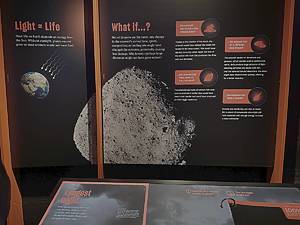
Visitors and aspiring paleontologists will travel through a chronological timeline of events–beginning at “Life Before the Impact,” with the chance to touch a real fossil of a Triceratops toe bone and a cast of Triceratops skin, before exploring “The Impact,” “Life After the Impact,” and finally, “Protecting Earth”–exploring a dramatic story of extinction, survival, recovery, and adaptation spanning millions of years.
Impact also presents the evidence for these extraordinary events from the fossil record and Earth’s geology. Roger Benson, lead curator of the exhibition and the Macaulay Curator of Dinosaur Paleobiology in the Museum’s Division of Paleontology, stated:
What makes this exhibition so exciting is how much of the story we can now tell through science. Advances in paleontology and geochemistry have given us an unprecedented look at what happened before, during, and after the asteroid hit—including how ecosystems collapsed, adapted, and ultimately flourished again.
Impact: The End of the Age of Dinosaurs opens to the public on Monday, November 17th.
Tickets that include admission to the exhibit start at $30 for adults, $17 for children (ages 3-12), and $24 for seniors and students (free for Members). Learn more on the museum’s website.
Know Before You Go
- ☄️ Impact: The End of the Age of Dinosaurs
- 📍 American Museum of Natural History – 200 Central Park W
- 🗓️ Open daily (except Thanksgiving and Christmas)
- ⏰ 10 am – 5:30 pm
While you’re at the museum, be sure to also check out Apex, the 150-million-year-old Stegosaurus skeleton that was unveiled at the museum December 2024!